Synopsis:
The media startup that I selected to work with this semester was Cheddar. I was very excited to have Cheddar as my choice because I was interested in the news aspect of the company. As someone who hopes to work in the broadcast news industry one day, I was extremely eager to learn more about how Cheddar operates as a business with their business model. Cheddar is a unique startup that broadcasts two news networks, Cheddar News and Cheddar Business, onto different streaming services such as Philo, Hulu, YouTube TV, and more. The company broadcasts every day from the trading floor of the New York Stock Exchange. The company was first started by Jon Steinberg in 2016 to provide content on news, entertainment, finance and more. As the company was getting started, it received a huge following from the Millennial and Gen Z generations. The goal of the company was then to develop these younger generations into people who are active in obtaining news. In 2019, Cheddar was acquired by Altice USA for $200 million. This was an exciting opportunity for Cheddar to grow. Since being acquired, Cheddar has grown to broadcast on a few small cable networks in the New York area. The company looks to continue to expand their market to reach more age groups and broadcast across the nation.
Developing the Case Study:
Guidelines followed:
As I was working on the case study project, I followed the guidelines of expressing all of the crucial information that people would want to know about Cheddar. I took a look at many different insights of the company such as who their leadership team is, how the company first got started, their financial information, their business model and more. When filling out the specific business model canvas for Cheddar, I followed the guidelines of what we’ve been learning in the Business Model Generation book. For example, I followed all of the subsections this book discussed with breaking down all of the different pieces that make up the business model canvas. Under value propositions, the book discussed newness, performance and customization as some examples to brainstorm. Another guideline I followed was discussing how much of a role branding plays into the company. Cheddar is known for their bright pink color and cheese block graphic. Their branding is consistent across every social media platform and really uses the bright color to draw curious viewers in. I personally was one of those who really didn’t know much about the company, however the logo drew me in to find out more. Overall, the biggest guideline that I followed was using my pure curiosity to lead me to find information about this company and how the startup came to be.

Challenges:
The biggest challenge I faced while working on the case study assignment was finding financial information. The goal of the financial management section of the case study was to get an inside look at what Cheddar’s budget looks like. Having access to their financial overview would allow me to evaluate their operating costs, yearly revenue, net income and how much they receive from their advertising. It was very frustrating and challenging because nothing about Cheddar’s financial information is available online. There wasn’t even a full SEC report available. The only information listed under the SEC was information regarding Jon Steinberg and the location of the company in New York. I was able to find out that Cheddar was acquired by Altice USA in 2019 which lead me to some valuable financial information. I was able to find a very full and detailed report about Altice USA that even discussed a tiny bit about Cheddar. Acquiring Cheddar actually offset Altice USA in some of their cycles. An example is that Altice USA’s revenue for news and advertising declined -2.3%. The challenging part about the information with Altice USA was finding a way to explain that Cheddar only accounts for a small portion of this company’s financial information.
Opportunities:
The biggest opportunity working on Cheddar for my case study was learning about a news company that I dream of having myself one day. I’ve always dreamed of working in the sports broadcasting industry. Ever since I was younger, I always thought it would be amazing to have my own company where I could produce content about sports. As I got older I began to understand how powerful the big media conglomerates are which made me question if a startup like this would even be possible. Learning about Cheddar taught me that it is fully feasible. Taking a look at the business model Cheddar runs on gave me great ideas of ways I could go about doing this myself one day. I learned what works very well for them, as well as areas that they are working to improve upon. I think it was a fantastic opportunity to learn about the ways Cheddar broadcasts onto streaming services. The younger generations continue to “cut the cord” and solely rely on streaming services as their news/entertainment provider. Cheddar opened my eyes to realize that cable isn’t necessary to do a broadcast, in fact streaming might become the way of the future. Aside from learning that my dreams are doable, it was such a fantastic opportunity to take a deeper look into a company and see how it runs. I came into this class not knowing much about entrepreneurship, however completing this assignment has helped me to understand many different terms and formats on how it works. Overall, it has been a great learning experience and I feel that having this knowledge in my back pocket will only help me, as well as make me more versatile.
Entrepreneurial Mindset:
As previously mentioned, I came into this class not knowing anything about entrepreneurship. I had a very slim understanding of what it means to be an entrepreneur. When someone mentioned the word “entrepreneur,” I would instantly think of people like Steve Jobs or Jeff Bezos. I tied that word to people that started companies that turned into ginormous dominant companies. I was always so interested in every class this past semester as I continued to learn about the behind the scenes part of becoming an entrepreneur. I remember first learning about the innovation process. Becoming an entrepreneur stems from taking a risk and inventing something new such as a product, service or a new way to do something. It stems from creativity, risk, hard work and optimism. Every guest speaker that came to speak to our class emphasized this process. They all were just ordinary people who creatively came up with an idea and took the risk. Sure, all of them felt unprepared and at some points had no idea what they were doing, however that is part of the process and what made them into who they are today. Lorie Hearn from inewsource was someone who really shared part of her journey in taking that risk. She heavily relied on teamwork to see the success of her startup. Throughout the course of the semester, I learned the type of skills that are needed to become a successful media entrepreneur such as team building, content development, social media marketing, pitching ideas and business plan development. I enjoyed learning about the ideation phase where one actually brainstorms an idea. During lecture we learned about utilizing sticky notes to visualize your plan, or sitting in a pod where you’re by yourself thinking. This really resonated with me because I am a person who is the most creative when I can lay the idea out in front of myself. Looking back on this semester, the biggest takeaway I have is a full understanding of how the business model works. This includes everything from identifying a target market, developing revenue strategies, startup funding and branding.
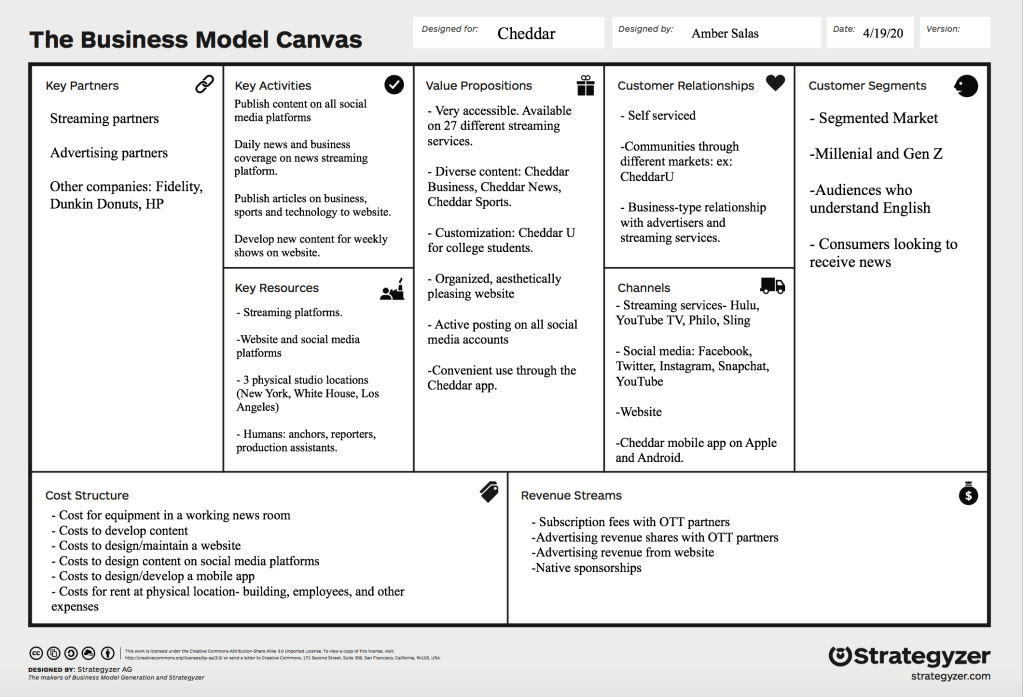
The experience from this class has helped me better understand the entrepreneurial mindset in the media industry as I now understand the behind the scenes work that happens. I now understand that these entreprenurs put in so much work every day in order to see their company’s success. They don’t just become successful overnight. It takes a great deal of planning, communicating and pivoting to different trends in the market. It was so beneficial to learn all of this information regarding the business model, then research how it plays out in media startups today. I really enjoyed all of the group activities we would do each class where we would apply the material to a real startup company. I filled out a business model canvas for Starbucks, Cheddar and evaluated other students’ canvas to see what they came up with. I felt that this was so helpful to apply what I was learning to a real company. I also think the weekly guest speakers were the most beneficial part of this class. It was so interesting to hear all of their stories. Each one of them was so different and took a completely different route to get to where they are today. One of my favorite guest speakers was Yusuf Omar because he was so open in his responses to all of our questions. I thought he was so honest about how he’s continually had to change and update his business model depending on what the current social media trends are. I thought he had a very inclusive idea of letting any person pitch a story idea for his company. He was the first entrepreneur I had ever heard speak, and he left me feeling very inspired to create something unique.

The business model is everything for determining if a startup will end up being successful or fail. When creating a business model, the entrepreneur must put together all of the puzzle pieces in order for the startup to become successful. Every block might be great, but if the revenue stream block doesn’t work then the company could fail. The key part in this aspect is using different strategies to assess the business model. The biggest thing is determining what’s called the SWOT of each building block on the canvas. That’s evaluating the strength, weakness, opportunity and threat. This allows the entrepreneur to see the flaws of their canvas and make changes. Another key aspect is comparing your startup to your competition. A competitive analysis allows one to see what their competition does, and how the entrepreneur can make their own product better. Finally, it is essential for the entrepreneur to stay updated on the changes in the media industry. For example, a new trend on social media like Tik Tok could cause a company to have to pivot and become active on that platform. In the media industry, things are always changing and it is very important to stay up to date. Gregg Anderson from 41 Orange is a guest speaker that I learned a lot from regarding the business model. Gregg unfortunately lost his company due to the coronavirus pandemic. While it was hard news to hear, it was inspiring listening to him talk about getting back up right away and developing a new plan for Origin 63. He realized what the pervious company did wrong in the business model and he’s made changes to prevent that from happening again.
“Fail Fast, Fail Early, Fail Often!”
One of Gregg Anderson’s 10 Secrets to Success
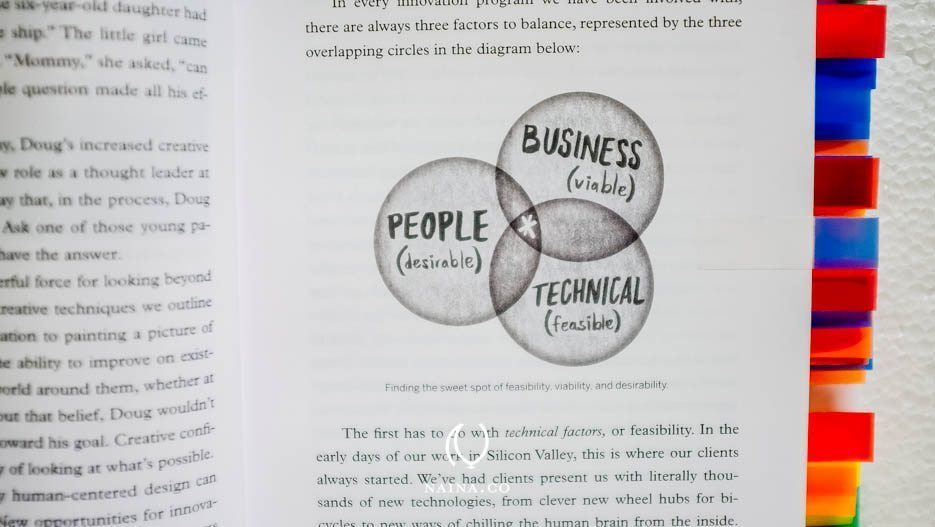
An entrepreneur wouldn’t have the chance to become an entrepreneur if it weren’t for creativity and innovation. That shows how important these two aspects are. They are everything when it comes to entrepreneurship. An entrepreneur develops a startup by using their creative juices to create something that has never been done before. Many people worry that they don’t have creativity and would never be able to become an entrepreneur. I personally have been one of those people that panic whenever someone says “use your creativity to come up with something new.” I really enjoyed reading the book Creative Confidence to learn more about how every person inherits creativity in some way. The book states that, “Creativity comes into play wherever you have the opportunity to generate new ideas, solutions, or approaches. And we believe that everyone should have access to that resource” (pg. 3). A big point the authors stress is that creativity doesn’t have to be built from scratch. Creativity can come from taking an idea that’s been discussed before, but then adding in your own spin to make it unique. Innovation is another aspect that Creative Confidence touches on. An entrepreneur comes up with their own innovation that they put out through their startup. The three key things in developing an innovation are finding the sweet spot between feasibility, viability and desirability. In order to be feasible, the technological aspects must be able to actually work. In order to be viable, the innovation must have the business factors to work economically. Finally, the innovation must be something people will possess a need for. These are just a few of the elements that make up creativity and innovation that are key to an entrepreneur’s success.
An entrepreneur should consider legal and ethical guidelines for their staff when creating a startup. There are existing ethical codes through organizations like PRSSA, SPJ and ONA that can get the entrepreneur off on the right foot. These journalism guidelines should always be considered when creating a media related startup. If the entrepreneur does not follow these guidelines, they could face legal issues with their startup such as defamation, libel or slander. It is very important to always publish accurate information, and these guidelines help the entrepreneur to do so. A tip that I learned in lecture is that the entrepreneur should always be careful about what is being published. Listed here are some of the biggest takeaways:
- Be specific – avoid ambiguity.
- Don’t post anything when one is emotional – upset or angry.
- If it’s a fact – make sure it’s true.
- Make sure opinions are clearly presented as such.
- Be cautious when writing about private citizens.
An entrepreneur should always be transparent and have their ethics codes public on their website. Copyright and fair use are other factors the entrepreneur should consider when posting content. It’s important to make sure one has permission before using content from the web. A final aspect the entrepreneur should consider is insurance to protect the startup. Insurance protects the entrepreneur as well as the operation. Some types of insurance the entrepreneur should consider include business owners insurance, worker’s compensation, health insurance, directors and officers insurance and general liability. These insurances allow the entrepreneur to protect the property, the business and the employees.
The most enjoyable part of the entrepreneur interview assignment was getting to visit the office space of Times of San Diego and see what the environment was like. Chris Jennewein rents office space out of Downtown Works, which is a home to many different tech startups that need space. It was beneficial to see that a huge office space isn’t always necessary for a startup. As Chris emphasized to me many times, cutting the cost is the most important part. Chris was so welcoming and really was invested in spending his time with me. As a person who hopes to be a reporter one day, I really enjoyed getting to craft my own questions I wanted to know about his company. I felt like my real job was to be a reporter that day and it was very exciting. Another enjoyable moment was the time Chris spent mentoring me in the goals I hope to accomplish one day. He asked me if I wanted to become an entrepreneur myself one day. I was a little worried to tell him “not at the moment” since my first goal is to become a sports broadcaster. For some reason, I thought he might only want to talk to me if I wanted to be an entrepreneur like him. To my surprise, he supported my goals 100% and spent about 20 additional minutes giving me advice about the industry. He even encouraged me with an idea that I could start my own sports media startup down the road. I greatly appreciate Chris taking the time to do this as I left feeling incredibly inspired.
While working on the entrepreneur interview assignment, the most challenging moment was trying to fit all of Chris’s valuable information into 6 pages. He gave me so many great, lengthy answers that I felt were so important to include. While writing up the paper, I had to decide which elements were key to include, and which ones could be left out for the sake of length. Although it was challenging, I personally feel that it was great practice for journalism. Every day, journalists are faced with the decision of what elements to include and a story, and which ones can be left out. It was also a fun challenge to tell the story of Chris Jennewein’s journey as best as I could. I had the goal of making this paper be a reflection of how Chris got his startup to the point it’s at today. There were so many elements Chris shared with me such as the many different positions he held at media companies that he felt were very beneficial to his development. It was exciting to put all of the elements together to share the story of how Times of San Diego came to be.
One of the key things I took away from the entrepreneurs I was privileged enough to listen to throughout the course of this class is that there is no need to rush. Many of our guest speakers shared how important it was for them to get experience in the industry before starting their company. Chris Jennewein talked a great deal about this, and said he spent time working at five different companies before starting Times of San Diego. He even waited until he was 59 years old and still created a successful company. I will take their advice and look to spend my first few years out of college at a news station getting experience in the broadcast industry. My hope is to be working in the sports broadcasting industry. Eventually, I would love to take my entrepreneurial mindset with me and create my own sports media startup. Chris Jennewein taught me that I could use the free services like Wix and Google Analytics to get the company up and running. I love the work that Cheddar has done in creating a news platform on streaming services. I am interested in taking all of this into consideration and work on developing my own innovations for how I could deliver sports content. It would be awesome to create a platform where people could come for all sports news. During the early stages of sports broadcasting, it was an industry that was completely dominated by males. As time has gone on, many women have paved the way in sports broadcasting and have become very successful. I think it would be awesome to create a team full of women who love sports and want to tell these teams and athlete’s stories.

